Wednesday, 27 March 2013

FOLKLORIC ~ The Good Shepherds

Photo, The Mirror Newsgroup

Tonight I cannot write of pretty things. It is too cold.

I've lived in London and in remote countryside and loved both ways of life. Cities - endless shops, easy accessibility to all hour food, well lit in the darkest night.  The English countryside is full of green magic, trees, flowers, hedges, gloriously scented and full of wildlife to enchant and educate us. But in winter snow and rain can cut you off from supplies and make roads impossible to navigate. Electricity, water and heating can fail. Those postcard pretty cottages with roses round the door are often freezing in winter as oil runs out, becomes too expensive and the wood pile exhausted. 


a local cottage

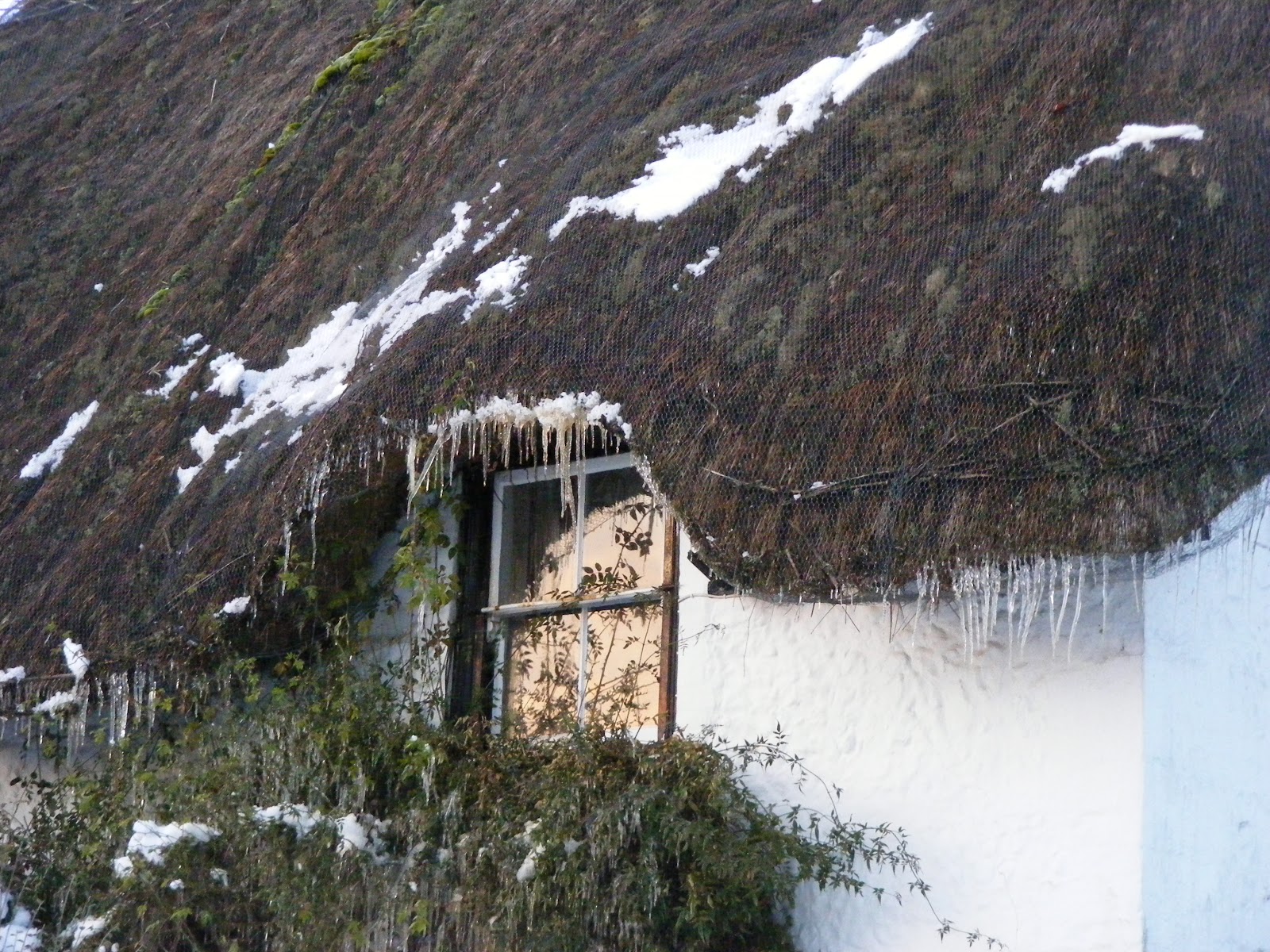
Ice hangs upon thatched cottages like the long icy fingers of The Snow Queen.

During hard times it seems trivial to write of luxury which so many do not have time for nor afford.  Beauty cheers us and lifts our spirits, inspiring us to create and share. Constant deprivation wounds us deeply and we withdraw into ourselves, our homes, reaching for the fire.  Gripped in the frosty embrace of a never ending Winter it is hard to summon Hope, but we must.

Winter remains. The usual promise of Spring is with us, woods carpeted in Snow Drops and Daffodil bloom along roadsides. But the sun does not come to melt the snow. Yet Easter is nearly upon us. Whatever your religious beliefs, it is impossible not to feel the sacred in the change of season from Winter to Spring - if only it would come. The stillness upon the land is beautiful - and deadly.

From deeper countryside than where our little cottage nestles came the heartbreaking news stories of sheep frozen under drifts giving birth to lambs. Desperate shepherds are often unable to save them before the freeze takes them where they lay.

The Good Shepherd by Richard Hook

Reporters listen to farmers whisper the realisation that their life as sheep farmers is over, beaten by nature, low prices for their produce and competition in the supermarkets from foreign lamb that can magically be offered cheaper than home grown.  In the future when we drive through English and Irish countryside empty of sheep and sheep dogs will we understand that those inexpensive meals we cooked helped to cause this wasteland?


When we grow up we look back at children's stories and sometimes think them foolish. But who dares laugh now at The Snow Queen who threw Winter over Narnia?

Whether we believe in Christ or not the Shepherd is a folkloric figure. These simple people have something highly mystical about them. Living so close to nature and facing hardships alone.


Illustration by Walter Crane

 It was impossible to watch the news footage of shepherds rescuing what they could of their herds and not shed a tear. Perhaps our tears will melt the snow and bring Spring to resurrect our joy. But for those who have lived through this and lost what they once knew, innocence is gone.

Innocence 1893 by William Adolphe Bouguereau

This Easter is unlike any other which I have ever known. More than ever we require faith, in something, to help us believe that Spring will come. And helping hands and hearts.  If you are in a cold place, help each other to stay warm. Wherever that you are be amongst friends and remember to share whatever each of us have with those who have not. 


Remember our neighbours, family and friends


Friday, 8 March 2013

FOLKLORIC ~ Magic Carpet Ride

painting by Apollinari Mikhailovich Vasnetsov

There are few things in life which we love in our youth and feel the same affection for years later.  When we downsized one of the items we could not quite bear to part with was a collection of what we called our 'magic carpets'.

Source: From Moon to Moon


These vintage carpets (and cushions and hangings)  had been lovingly sourced from charity and antique shops, given to us by family and bought in markets on trips to Iran.


For over a decade we had lived in houses which needed them. They had lain on long wood corridors and been lain upon by a series of cats, some past and some present who had also graced our homes.


Our favourite Bohemian cat
One rug in particular was known to us for even longer, going back some 25 years. It had been a covering in the bed of a giant Hound named Tennyson who had gnawed on it and left little holes in the fine embroidered wool.


All of our cats have dreamed of flying on the Magic Carpets
 
The new cottage was small, humble,  and different. No long corridors, no dark wood polished floors or 300 year old Elm floorboards needing adornment. We considered for sometime over the future of these carpets. Some were passed on.  It was hard to part with them, each held many memories.

Meanwhile we were struggling to decorate a small garden room. 'Garden' seemed to equate to soft romantic colours, as in the shabby chic signature style of Rachel Ashwell. Lots of white, pale pink, blue, lilac and of course green. We tried to get the room together around some Wedgewood majolica leaf plates we have although they were at least two shades darker than pale.


Antique Wedgewood Majolica

 Bar them, pretty though it was, the 'shabby chic' look for us would require all new items. And what were we to do with our old 'dark decor' things that had kept our company through our youth?


And then as so often happens, an old photograph of something we loved from the past inspired us. Rudolf the most perfect of Bohemians with the kelims he loved so much. (More about him and his carpets in a later post).


 Source: House and Garden magazine, 1992, a few months before Nureyev died.
With some of his beloved carpets at his home on Li Galli, off the Amalfi coast. 
 
And once we saw it, we knew. The garden room,  with the tiled floor, studio pottery, oak table, peacock chair and blissful light, was in fact the perfect place for the rest of our old carpets. And, as our conservatory is nothing ancient or grand the carpets would give a much needed 'lived in' air to the modern space.
 
The way in which the Bloomsbury Set layered colours, textiles, paintings, pottery and sculpture has long inspired us. I had been trying to force a pretty ladylike pale and interesting scheme upon our garden room - and it just is not who we are.

Instead - viola! We can have an orange and blue garden room which picks up the colour of these wonderful magic carpets, with the green Wedgewood as accent. This room overlooks a 150 year old red brick bakehouse with terracotta roof tiles and the colours outside complement inside. If summer ever arrives we plan to plant the garden view full of  jewel coloured flowers. 


Tennyson's blanket on the carved oak bench in the conservatory,
with an Edwardian carpet underneath.

Never too many cushions.


Mrs Black loves her old carpets.


Garden rooms do not have to be pastel! Wouldn't this be a wonderful stimulating place ?


Source: www.emel.com

Friday, 15 February 2013

SEASONS ~ The Snow Drop Fairy has come


We love Autumn and Winter and have enjoyed being in our little snow covered village perched atop Wiltshire. Even though some cold remains after Valentine's Day the romance of it always seem to herald a new season, a warmer, floral one. The icy winds have turned more gentle, the snow has melted, the Thrush is singing.

1930 Cicely Mary Barker


During the cold and dark of Winter underneath the snow tender stems and blossom of snow drops were waiting and now they gift us with their Heavenly scent and delicate vision.  Even though they come each year, how could our hearts not be filled with a little joy at the sight of them?


Cafe tables are adorned with the buds of Daffodils, and soon the morning sun, just glinting briefly, will lengthen into hours. A perfect reason to wrap up warm and go outside. It is a lucky thing to be alive in Spring.


Tuesday, 12 February 2013

CELEBRATIONS ~ On Valentine's Day

True love is like ghosts, which everyone talks about and few have seen.

- Francois de la Rochefoucauld


The Legacy of St. Valentine


True love is rare, and yet many of us experience it. If you have been one of the lucky ones, hold close and treasure your love. And do not forget to show gratitude on Valentine's Day!

It is easy to accept events and celebrations such as Valentine's Day without giving them a second thought, or knowing why we do celebrate them. It is impossible to recount the history of how Valentine's Day came to be but it is believed that it derives from one of three patron saints, or perhaps even an amalgamation of them.  Like most successfully long lived celebrations it has both christian and pagan elements.
 
The following definition on the pagan celebration of Lupercalia, which may well be related to our current Valentine's day, is from From Wikipedia, the free encyclopedia


Lupercalia
Lupercalia
Lupercalia most likely derives from lupus, "wolf," though both the etymology and its significance are obscure (bronze wolf's head, 1st century AD)
Observed byRoman Kingdom, Roman Republic, Roman Empire
TypeClassical Roman religion
DateFebruary 13—15
Celebrationsfeasting
Observancessacrifices of goats and a dog by the Luperci; offering of cakes by the Vestals; fertility rite in which the goatskin-clad Luperci strike women who wish to conceive
Lupercalia was a very ancient, possibly pre-Roman pastoral festival, observed on February 13 through 15 to avert evil spirits and purify the city, releasing health and fertility. Lupercalia subsumed Februa, an earlier-origin spring cleansing ritual held on the same date, which gives the month of February (Februarius) its name.
 
The name Lupercalia was believed in antiquity to evince some connection with the Ancient Greek festival of the Arcadian Lykaia (from Ancient Greek: λύκοςlukos, "wolf", Latin lupus) and the worship of Lycaean Pan, assumed to be a Greek equivalent to Faunus, as instituted by Evander.
 
In Roman mythology, Lupercus is a god sometimes identified with the Roman god Faunus, who is the Roman equivalent of the Greek god Pan. Lupercus is the god of shepherds. His festival, celebrated on the anniversary of the founding of his temple on February 15, was called the Lupercalia. His priests wore goatskins. The historian Justin mentions an image of "the Lycaean god, whom the Greeks call Pan and the Romans Lupercus," nude save for the girdle of goatskin, which stood in the Lupercal, the cave where Romulus and Remus were suckled by a she-wolf. There, on the Ides of February (in February the ides is the 13th), a goat and a dog were sacrificed, and salt mealcakes prepared by the Vestal Virgins were burnt.
 

~ ~ ~


In the history of the Catholic Church the various saints named Valentine or Valentinus were all martyred but their stories are lost to history and have passed into legend. One theory is that Valentine was a priest who served during the third century in Rome. When Emperor Claudius II decided that single men made better soldiers than those with wives and families, he outlawed marriage for young men. Valentine, realizing the injustice of the decree, defied Claudius and continued to perform marriages for young lovers in secret. When Valentine's actions were discovered, Claudius ordered that he be put to death.

Other stories suggest that Valentine may have been killed for attempting to help Christians escape harsh Roman prisons, where they were often beaten and tortured. According to one legend, an imprisoned Valentine actually sent the first "valentine" greeting himself after he fell in love with a young girl--possibly his jailor's daughter--who visited him during his confinement, and whose sight he is said to have restored. Before his death, it is alleged that he wrote her a letter signed "From your Valentine," an expression that is still in use today. Although the truth behind the Valentine legends is murky, the stories all emphasize his appeal as a sympathetic, heroic and, most importantly, a romantic figure.
By the time of the Middle Ages, perhaps thanks to this reputation, Valentine would become one of the most popular saints in England and France.

Vintage Valentine Day cards


I especially love this little fold out Red Riding Hood card!


Valentine greetings were popular as far back as the Middle Ages, though written Valentine's didn't begin to appear until after 1400. The oldest known valentine still in existence today was a poem written in 1415 by Charles, Duke of Orleans, to his wife while he was imprisoned in the Tower of London following his capture at the Battle of Agincourt. (The greeting is now part of the manuscript collection of the British Library in London, England.) This is the translation from the French and I am certain it would lose some of the romance in translation.

I am already sick of love, My very gentle Valentine,
Since for me you were born too soon, And I for you was born too late.
God forgives he who has estranged/Me from you for the whole year.
I am already sick of love, My very gentle Valentine,
Well might I have suspected, That such a destiny,
Thus would have happened this day, How much that Love would have commanded.
I am already sick of love, My very gentle Valentine.

Several years later, it is believed that King Henry V hired a writer named John Lydgate to compose a valentine note to Catherine of Valois.


Much of this text and research is from Here:

You can read more about The Duke of Orleans Here:


The early tradition of Valentine's Day was that it was the date that birds began to choose their mates, only later did the romance extend to the human population. The first reference in print to Valentine's Day is found in Geoffrey Chaucer's The parlement of foules [The Parliament of Fowls], circa 1381:
For this was on seynt Volantynys day Whan euery bryd comyth there to chese his make.
[For this was Saint Valentine's day, when every bird of every kind comes to this place to choose his mate.]
How the date of 14th February was selected isn't known. It may relate to the approximate date first anniversary of the engagement of King Richard II of England to Anne of Bohemia, which Chaucer's poem was written to honour. The couple were both 14 at the time of the engagement, which took place on 2nd May 1381, not on 14th February. The betrothal of young lovers sounds promising as a romantic story bit, in fact it wasn't. The marriage was purely a political contract between Anne's brother, King Wenceslas IV of Bohemia and the English government - the partners were unlikely to have met prior to the marriage.
 
Perhaps in a throwback to the ancient tradition that birds chose their mates on this day it became the first day that thoroughbred stallions covered mares to produce the frisky foals as soon as possible in the New Year which would grow into strong racehorses whose pedigrees would be duly recorded on the pages of the General Stud Book started in 1791 by James Weatherby and still kept today at Weatherby's.
 

The Godolphin Arabian  (c. 1724 – 1753) one of 3 founding fathers of the throughbred racehorse.
painted by George Stubbs, here with his cat Grimalkin.

A stunning sight. Mares and Foals Disturbed by an Approaching Storm, George Stubbs

 
Footnote: The vintage Valentine Day cards were taken from those available to purchase on Ebay.
 

Wednesday, 6 February 2013

PESKY PIXIES

Pesky Pixies in the garden
 
I often post about Fairies and Pixies, they have been a fascination and inspiration all of my life. Once upon a time I thought I was growing out of them, they retreated to the shadows, behind day to day life, but they remained.

My childhood was spent in a series of uninteresting mass produced houses with white interiors and a constantly changing selection of modern furniture and objects.


My imagination was freed by the old china and books which were left forgotten on my Great Grandmother's display stand which had somehow managed to end up in a dark corner of our house. It's gnarled wood and chipped paint with it's 'one of a kind' bits and pieces had a terrific pull for a small curious child. Convinced as I was that the Fairies at the bottom of the garden had put it there just for me, I kept my passion for it secret. Those objects created a lifelong fascination for vintage items and later gave me a career. 


Our houses were devoid of personality but the gardens were always enchanted and full of wildlife. Father had green fingers and loved all living things, and they loved him back. Each time we moved he would begin again the process of planting trees for the birds, flowers for the Bees, Butterflies and Moths, vegetables for us and a pond which would magically become inhabited by insects, newts and Fairy Folk. He worked in a sawmill and had a bond with anything wooden. When I was 7 he built me a play house complete with running water. It was my own cottage in the woods of our back garden in suburbia. We had no money but Fairies really did live at the bottom of the garden, there was a white Wolf in the Woods, and the Pesky Pixies caused all kinds of havoc but would upon occasion agree to help with household and garden chores.


This enchanting image is from Here:
 
Grandparents lived in old houses filled with china, dark wood and paint colours, patterned carpets and overstuffed upholstered sofas and armchairs. When I visited I slept on a velvet drop arm sofa under antique handmade quilts.


It is funny how our past forms our future and makes us who we are today. I thank the teacher who gave me a great love for books, and those in my family who showed me that treasure can come from unexpected sources, and does not always have to cost a fortune.

As for those Fairies and Pesky Pixies ...... they are still with me, on china and at the bottom of the garden.

postcard by Lorna Steele published by Salmon Ltd England


Friday, 25 January 2013

FAIRY ARTISTS ~ Thomas Bromley Blacklock

 "Red Riding Hood" 1899, by Thomas Bromley Blacklock (1863-1903).
Oil on canvas, 66 x 91.5cm. London Art Market, Sotheby's, 26th August 1997, Lot 1445
 
Although we are continuously drawn towards the familar and much loved images and artists we know, we also like to pay tribute to lesser known talents from the past - and the present. No matter how old we are it remains a great delight to discover something new which becomes a treasured favourite. No one has said it better than John Keats, "A thing of beauty is a joy forever".

Today the internet and the plethora of magazines make thousands of images available to us without having to go to a gallery or a library. We are able to enjoy so much more, but often the paintings are posted or printed without the artist's name or story attached. When we use images we always try (sometimes in vain) to find out who created them and add a link to further information. 

We have a few images saved which have charmed and beguiled us, and never cease the search for their story. The name of Thomas Bromley Blacklock was unknown to us until recently when we were researching some of these images and found them on A Polar Bear's Tale enchanting and informative journal.    Here   We owe her a great debt for two reasons, the beauty which she shares with her readers, and the archive of information she has accumulated on art and artists. Without her we would never have known who painted these images of The Fairies Wood, or The Snow Queen and been able to then identify Little Red Riding Hood as being by the same artist.

The story of Thomas Bromley Blacklock ends tragically, but his spirit must have burned brightly to have been able to paint so vibrantly.

Thomas Bromley Blacklock


Thomas Bromley Blacklock was born in 1863 in Kirkcudbright, Scotland, and tragically died in 1903 at the young age of 40 when this handsome and extremely gifted man drowned himself in The Clyde.

The son of the English teacher at Kirkcudbright Academy, Thomas was trained in painting in Edinburgh, working mainly in pen and ink and later in oils in East Lothian before returning to Kirkcudbright. He was inspired by the local landscapes which feature in much of his work and he captures their haunting beauty perfectly.  At some point he began to include children and fairies in the scenes and some of his later works allude to Galloway folklore. This does not detract from the landscapes but only adds to the enchanting quality. It is easy to imagine that he felt happy in such places and was cheered by the presence of the children and fairies while working alone in solitude. 

His last residence was at Church Place, Kirkcudbright which became well known as something of an artist's community with William Stewart MacGeorge and  E A Hornel also working there.

There is little recorded about Thomas and we know almost nothing of what torment drove him to end his life when he was at the height of his artistic development. Apparently he suffered a severe spinal ailment which is believed to have made his life intolerable. He lies buried in Kirkcudbright Cemetery.

His work was exhibited Royal Academy; Royal Scottish Academy; Aberdeen Artists' Society; Royal Glasgow Institute of Fine Arts; Liverpool.


"In the Fairies Wood", 1903. Oil on canvas, 60 x 72.5cm. London, Sotheby's. Lot 856, 8/83

Probably the picture shown as 'Fisher Girls' at the RSA, 1903, and RGI 1904.
sold at Bonhams Edinburgh 'Scottish Sale' in 2009 for $75,471


Bo Peep

A delightful little oil very much in the style of Hornel and full of dappled light and shade.
A real collector's piece for anyone enthusiastic about Scottish paintings. Acquired from an estate in the United States and sold by James Alder Fine Art.

On the BBC website you can see a slideshow of 17 works by Thomas. Do have a look, they are stunning. His remarkable spirit lives on in his paintings.

Thomas Bromlety Blacklock on the BBC website


Thank you to James Alder Fine Art for some of the information used in this post.

James Alder Fine Art


Wednesday, 16 January 2013

JACK FROST

Icicles on a thatched cottage nearby


As most of England is covered in a hard frost and snow is foretold for this weekend it is not surprising that thoughts have turned to the character Jack Frost, or Father Frost as he is sometimes known.


Father Winter by ~alexson1 on deviantART,
Ivan Bilibin's watercolor illustration, "Father Frost" from Tales of Russian Grandmother,
Jack Frost by Arthur Rackham

Folklore on Jack's character is mingled with that of Father Winter and St Nicholas. The story has some origin in Russia folktales where Father Frost is in fact the same as St Nicholas, known to us as Santa Claus. But this Santa is quite different from the jolly fat man in a red suit who shimmies down our chimneys on Christmas Eve. This one is more of a pagan forest figure.

A Russian illustration of Father Frost, a Pixie rendition by unknown artist
and Jack casting his frosty fingers over all,  by Arthur Rackham.

Jack Frost is also seen as a kind of sprite in a pointy hat who mischieviously paints frost on Autumn leaves thus bringing winter to the land. He's close to being a male version of The Snow Queen, but perhaps not as evil as she is usually portrayed, as in Narnia. Although some versions of him are quite scary and spiky!

Spiky Jack, artist unknown to us. 

There is nothing to do but, stay warm,


Enjoy the art of Jack Frost,


Settle down with a good book,

Girl with a Book. Pietro Antonio Rotari (1707-1762).


And don't forget to feed the birds! 

1929 Louis Icart (French, 1888-1950) ~ Les Frileux (The Chilly Ones)


Related Posts Plugin for WordPress, Blogger...